|
A Model for Understanding Thinking |
||
| Home
Marriage Enrichment
|
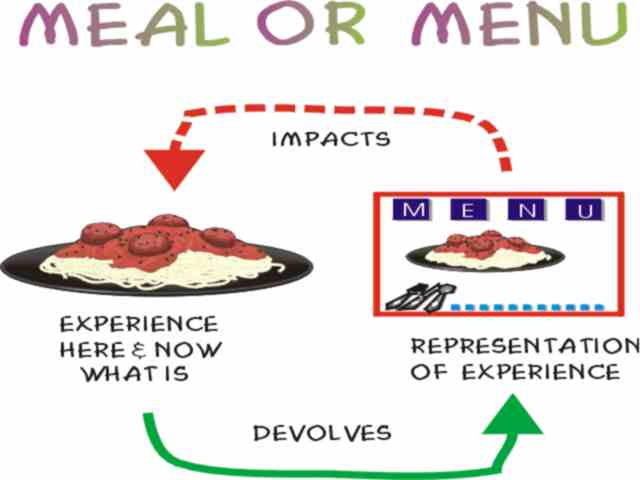
Every moment of experience, the here and now or "what is" of life immediately becomes represented in our awareness. We have a thought or thoughts about each and every moment. This process is continuous, constant and seamless. It is also very essential. Without this brain mechanism, we would all be a whole lot more scared, confused and lost. Think for a moment what it would feel like to have no way of "knowing" that all of the people who are close to you, yet are not in the room with you right now, still exist. Given that you do not have any direct experience of them right now (they are not in the room with you so you can't see, hear or touch them) you do not know they exist. What you have is a representation of their existence in your mind. There are other forms of what I mean by representation of experience:
None are "wrong." It is important to see them for what they are: the menu not the meal. They represent conclusions drawn from experience, fears about what we have experienced, hopes or dreams of what we might experience, our collective wisdom, our family history, indeed, the history of human civilization. Very important stuff! But none are "here and now" experience. Intimacy is a "here and now" experience. However, all our thoughts, memories and expectations about intimacy are menu items, not the real thing. In your relationship, it is important to place an emphasis and to focus your awareness on the "here and now" aspects of your problem solving. The traps that people get stuck in nearly always reflect some measure of eating the menu or paying more attention to their thoughts about their partner not what their partner is actually expressing (expressing includes more than the words. It includes the non-verbal or body language and all other behaviour and emotions). The attention becomes fixed on one of the items in the list above. When partners are eating the menu, another image comes to mind that I usually share with my clients. I suggest they imagine a pony track. The pony is pulling a cart endlessly around this oval track. As the pony proceeds, the ruts get deeper and deeper. As well, the bodily functions of the pony result in the manure getting higher and higher. Eventually the pony is plodding through more and more shit and can't see over the ruts of the track. Many couples acknowledge that their disputes take on both characteristics of the pony track. They go round and round in circles and it really stinks! I find it helpful to consider thinking in this way. I imagine that I have a little voice in the back of my head. I listen to that voice but I am not bound by it or in servitude to it. If I am problem solving a situation and the voice is saying something like "The last time you gave in; now it's your turn!", I thank my mind for sharing, consider if the comment or information or advice is useful to the situation I am addressing and re-focus on my present situation. The issue in question may in fact be best resolved by me "giving in" again. If I followed the voice in the back of my head, I wouldn't give myself the freedom in the moment to choose what is best. It is crucial to break the tyranny of our thinking. Thoughts should only share the stage, not direct the whole performance. Albet Ellis, a pioneer in the field of behaviour therapy, has developed a very useful strategy for managing our thoughts that get in the way of living in the moment. Think of how many times in your life you have made plans to do something outside. Perhaps you have made plans to take your loved ones to a park, or to the beach. On the appointed day, you look outside only to discover the worst thunderstorm of the year. You are understandably disappointed. Yet do you go outside and shout at the rain? Do you swear that you will never trust the weather again and plan a trip outdoors? I hope not! You shrug your shoulders and say to yourself "oh well, it's raining." Sometimes when our partner does or says something to us that we don't like, the best option in the moment is to say silently, "oh well, it's rain." In addition to reducing the risk of an escalating argument, these strategies that put thinking in its place have another very important outcome. When you allow your thoughts to occupy a part of your attention, not all of it, you open the possibility of increasing your awareness of your feelings, the next topic of responsibility for self. Let's get into our feelings! |
