|
Lesson 4 |
I Am Willing to Know My Partner |
|
| Home
Marriage Enrichment
|
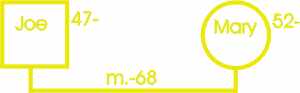
I heard it said most recently on the TV show "Alley McBeal" regarding relationships: "You spend all your energy finding the perfect partner. Then when you get married you try to change him (her)." Not only does Intimacy require the ability to get to know your partner and rejoice in your partner's behaviour that fits with your expectations or beliefs about what a relationship and your partner should be. The tougher job is to be willing to respect your partner's right to make choices that you do not want or understand as contributing to the relationship. You may be hurt by his or her behaviour; you may be very angry. The principle to hold on to is that you demonstrate your respect for your partner to make decisions about his/her life. You especially need to do this when you are in disagreement about some important matter. Otherwise, your disagreement or disapproval can very soon be experienced by your partner as an attempt at control or personality makeover. Getting to Know Your Partner Most relationships start with a curiosity or desire to know another person. If the object of the curiosity is a friend of a friend, it is not uncommon to pump the friend for as much information as possible before making the first overture. In the beginning stages of a relationship, both partners tend to ask lots of questions of each other. The research is geared towards determining if there are shared interests. How similar is often perceived as a predictor of how compatible. It is unfortunate that when enough compatibility is discovered to cement the relationship, the energy previously afforded the desire to learn more about one's partner dissipates. So the challenge is to continue to foster your curiosity about your partner. The first place to explore is your partner's family of origin. How much do you know? I find it helpful to develop a family genogram with the couples I counsel. Not only does it help me keep family information straight, it also provides a forum for each partner to learn more about their partner. A genogram is simply a map of your family that uses lines, squares and circles to represent the various members of the family. To start, draw a line in the centre of a page to represent your relationship. At the right end of the line draw a square, representing the male partner. At the other end of the line, draw a circle to represent the woman. In same sex couples, use the appropriate symbol at each end.
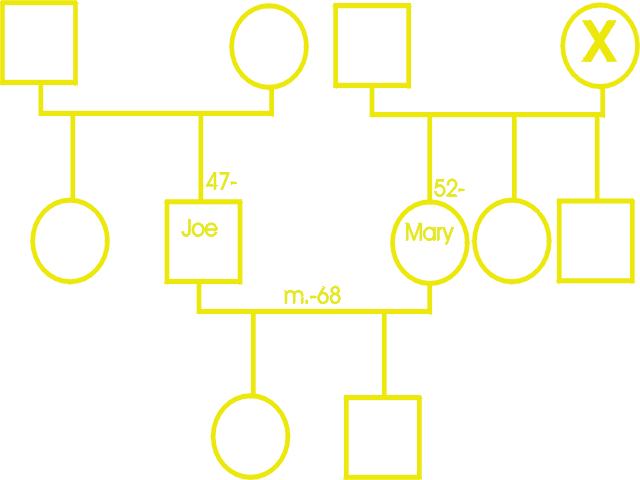
In the above example, Joe married Mary in 1968. Joe is 51 and Mary is 47. Children and parents are added down and above the relationship line respectively.
In the above genogram, Joe and Mary have two children: a girl born first and then a son. Joe is the youngest of 2; Mary is the oldest of 3. Mary's mother has died. When you complete your genogram, fill in as many dates, names and relatives as you can find. If you have children, this project can be very meaningful to them to share with you. After all the facts, what next? |